I was twelve years old the first time I played GTA: Vice City on a machine with 256 MB of RAM. It wasn’t running the game; it was surviving it. The game crawled at less than 20 frames per second. Cars stuttered. Animations lagged. By today’s standards, it should have been unplayable. I do not remember much of its story, but I do remember the feeling.
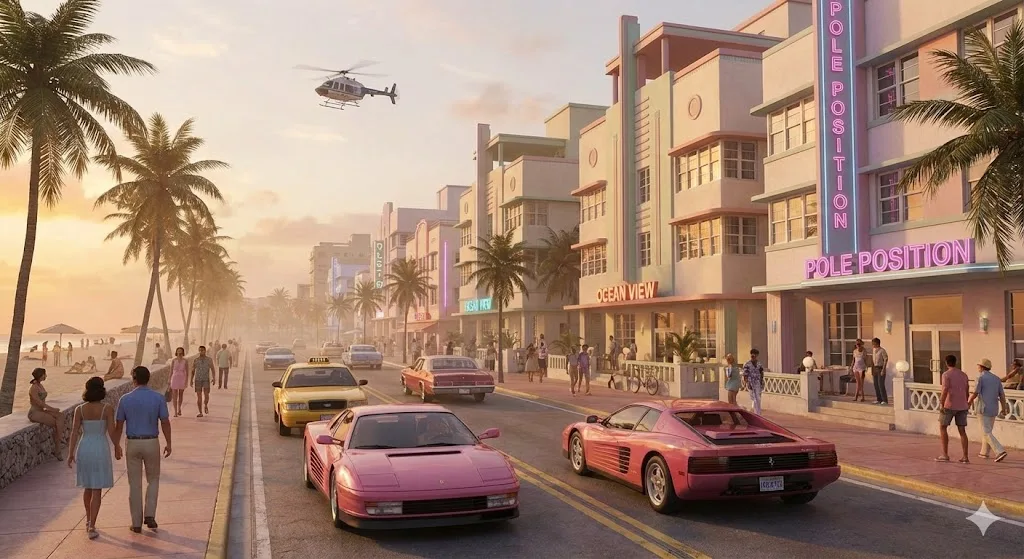
Nevertheless, it felt real. The world behaved like a world, not a theme park designed for my amusement. I could steal a car and then it slam into a wall, sprint into a dead-end alley, or just stand on a street corner and do absolutely nothing. The city didn’t panic. It just carried on. The city didn’t reward me for exploring, didn’t punish me for wasting time. It didn’t tell me who I was supposed to be. It simply existed, and I happened to be inside it. That was the magic. Not immersion through spectacle, but immersion through indifference.
For most of gaming history, games have started with stories not because stories are essential, but because computers needed scripts. Worlds couldn’t reason, remember, or deal with ambiguity. Designers had to predefine meaning. Dialogue trees replaced conversations. Quests replaced incentives. Endings replaced outcomes. The industry quietly accepted an assumption: a game begins with a story, and systems exist to move the player through it. Even open-world games follow this logic beneath the surface. Choice exists, but only within prewritten paths.
PUBG broke this assumption without ever trying to. This game had no story. Mediocre graphics. Clunky user experience. Yet it exploded because humans were the core system. This game didn’t need to author the drama. It simply hosted it. Every match was distinct not because of the code, but because of the people inside it—different instincts, different panic thresholds, different mistakes under pressure. The uncertainty wasn’t a random number generator. It was the terrifying unpredictability of another human being.
The point I am making here is, games feel alive when they mirror how humans experience reality: ambiguity instead of clarity, consequence instead of closure, memory instead of reset, imperfect agency instead of heroic control.
This is where Artificial Intelligence changes the core of gaming—not by making non-player characters talk better, but by breaking the assumption that games must begin with stories at all. They will start from simulated realities with invariants: agents with goals, incentives instead of quests, memory that persists, and time that actually matters. Story will emerge as a by-product, not a design artifact—an epiphenomenon of agents, incentives, memory, and time.
When that happens, players will stop asking, “What should I do next?” They’ll start asking, “Who am I becoming in this world?” That’s no longer gaming as entertainment. That’s gaming as experience formation.
A reasonable question at this point is why I’m writing about gaming at all, when I usually write about quantitative finance. When I think about truly long-term investments, say, fifteen years or more, I don’t start by asking where trends are going, or where markets are mispriced. I start by asking a harder question: where is humanity going?
I believe Artificial Intelligence and gaming is a signal (not an investment advice). It suggests a future where humans increasingly spend time inside simulated worlds that feel socially and emotionally real, not because of graphics, but because they mirror how humans experience reality itself. Ambiguity, consequence, memory, imperfect agency. The same primitives that govern real life also govern markets.
If markets are downstream of human behavior, then industries that capture attention, identity, and lived experience over decades matter more. For that reason, I remain structurally, long-run bullish on the gaming industry—not because of graphics, or, hype cycles but because it sits closest to where human experience itself is heading.