Why does this shiny yellow metal command so much value? You can’t eat it. It doesn’t power anything. It has no cashflows. Rarer metals exist. Stronger metals exist. Smarter alloys exist that are harder, tougher, more useful, more resistant to time and corrosion. By every engineering metric, gold should be mediocre. And yet it sits at the center of global wealth, central bank vaults, and collective panic. What am I missing here? It looks irrational until you break it into these four simple ideas.
1. Tell a lie, a million times and it becomes truth
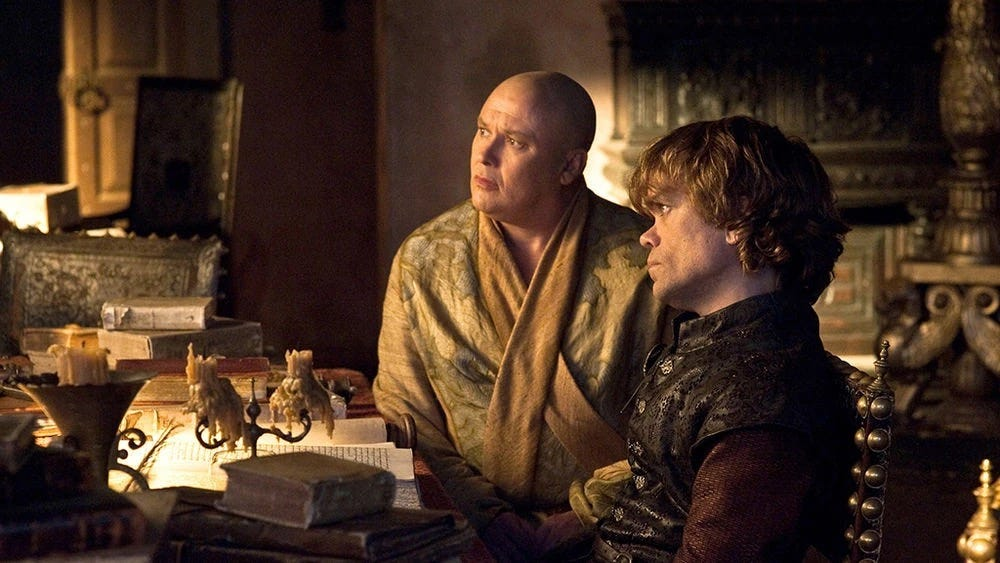
I was watching Game of Thrones again when that scene came up. The room is quiet. Varys stands there, hands folded, face unreadable.
He looks at Tyrion Lannister and puts a riddle to him:
“In a room sit three great men, a king, a priest, and a rich man, with a sell-sword standing before them. Each great man bids the sellsword kill the other two. Who lives? Who dies?”
Tyrion answers the way a smart man answers when he senses a trap. He shrugs slightly and says it depends on the sell-sword. Practical. Sensible. Almost dismissive.
Varys counters, but why should it depend on the sellsword? The king commands an army. The priest invokes heaven. The rich man promises coin. Three forms of authority, competing for belief but the sell-sword has none.
Then Varys delivers the answer. Flat. Unadorned.
“Power resides where men believe it resides. No more and no less.”
You can watch this scene here.
And in my opinion, this single line resolves the entire puzzle of why gold is valuable.
We begin by asking a basic question. What exactly is value? Value is not intrinsic to matter. It is not hidden inside atoms. It is a relationship between a human mind and an object.
It emerges from the tension between scarcity and utility, between limited supply and human desire. Where belief about scarcity and desire concentrates, value concentrates with it.
2. Humans survive through telling stories
I have read Yuval Noah Harari a lot. No other species in the known universe can create music, poetry, mathematics, love, and fight organised wars. Humans do because of the shared stories we keep telling ourselves. One of the most durable stories we ever told ourselves is gold as a store of value.
If you bought gold in 25 CE (during the reign of Emperor Tiberius) and held it until today, your real inflation-adjusted annual return would be somewhere between -0.03% and +0.03%.
That sounds underwhelming if your brain is trained on “alpha” and market-beating charts, but in the context of history, a 0% real return over two millennia is arguably the greatest financial achievement possible. It means you achieved perfect preservation of wealth while every empire, currency, and equity market around you turned to dust. Put bluntly: the long-run real return of every other asset class since 25 CE is -100%.
3. Humans are creatures of habit
Being 20% better may not be enough. There could be better-tasting noodles than Maggi in my native country India. There could be terminals more elegant than Bloomberg. There could be spreadsheets that outperform Excel. But people don’t switch easily.
Once gold becomes the common settlement asset, moving away from it becomes costly. Scales are built for it. Purity rules assume it. Coins, contracts, and trust quietly depend on it. This is path dependence. “Better” doesn’t necessarily beat what’s already everywhere. Being slightly superior often loses to being universal.
4. The secret is that it is not a secret ingredient
My final point is about stability of value. And this is where gold’s apparent weakness turns into its strength: it has very little industrial use. If something is heavily used in industry, it stops being money and starts behaving like a commodity. Prices swing. Demand shocks punch holes in valuation. Supply wakes up the moment technology improves and floods the market. Useful things are volatile by nature.
Money can’t afford that kind of excitement. Money needs to be boring. Predictable. Almost inert. Productivity is great for factories. Stability is non-negotiable for money.
So gold is what remains when confidence collapses and stories unwind. Gold is valuable because it sits at the intersection of belief, habit, coordination, and boredom. It survives not by outperforming, but by refusing to fail. Not because it does anything, but because everyone agrees it doesn’t have to.